Ptosi TOH-see. The P is silent.

Most fall detectors wait for the impact.

A faint does not always have one. You slide down a wall, or your knees go and you fold onto the carpet, and nothing hits hard enough to count. Ptosi watches the descent instead, then checks whether you got up.

iPhone, with an Apple Watch app in testing. Not a medical device. It never calls an ambulance.

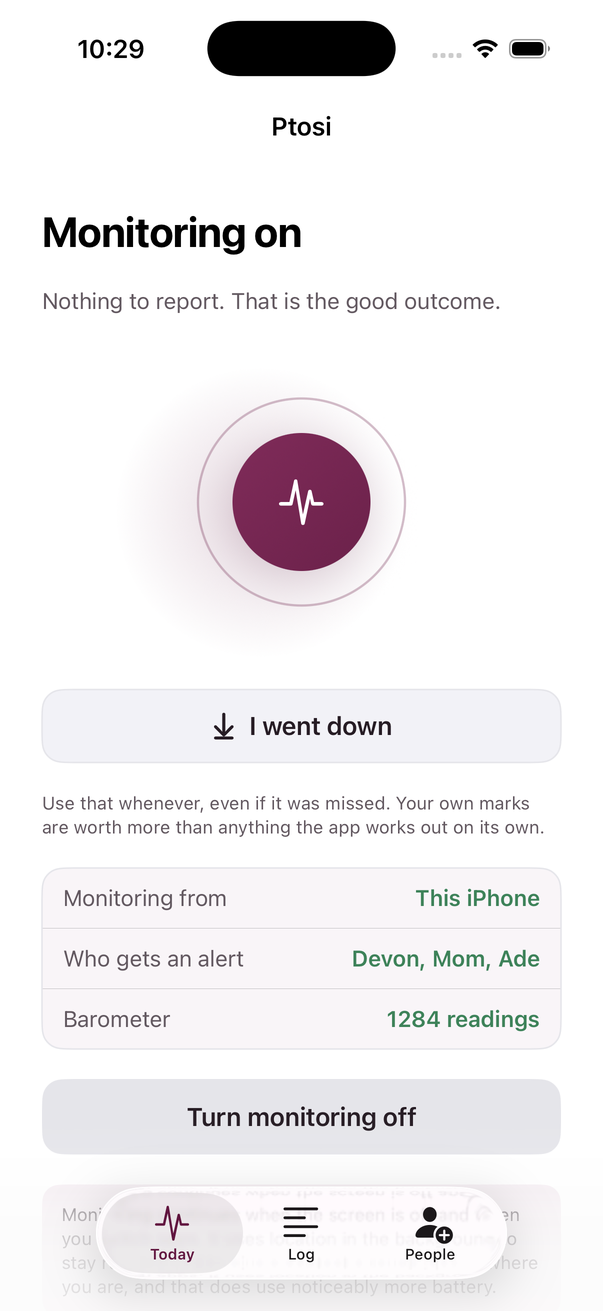
The Ptosi home screen with monitoring running. It reads Monitoring on, nothing to report, that is the good outcome, and lists Devon, Mom and Ade as the people who would be told.

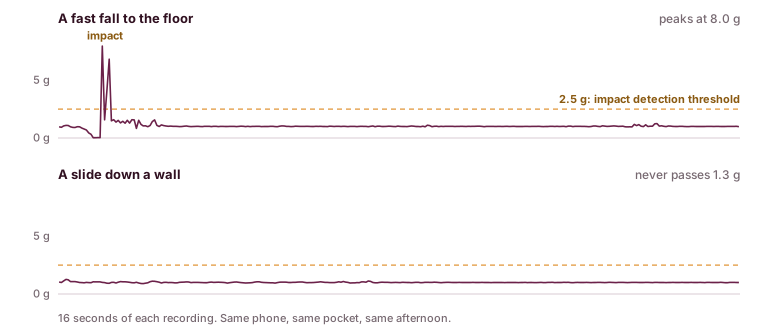
Both of these end on the floor. Only one sets off an impact detector.

Fainting does not always drop you. If your knees go while you are against a wall, a counter or a doorframe, you slide, and the phone in your pocket feels almost nothing on the way down.

Two recordings, same phone, same pocket, same afternoon. The fast fall spikes to 8.0 g, which any fall detector on the market will catch. The slide never passes 1.3 g, barely more than standing still, and stays under the threshold the whole way to the floor. There is nothing there for impact detection to find.

Two acceleration traces. A fast fall to the floor spikes to 8.0 g, well past the 2.5 g an impact detector waits for. A slide down a wall never rises above 1.3 g and stays below the threshold the whole time.

Real sensor recordings, not a diagram. Both were staged on purpose: nobody fainted to make this chart. Measuring how often the slide case happens in ordinary life is the next job, and it is not done yet.

So Ptosi does not wait for the jolt.

It watches you go down instead. That alone is not enough either: bending to tie a shoe measured a bigger drop than one of these falls did, so a detector that fires on descent would alarm every time you knelt to pick something up, and you would turn it off inside a week. Descent opens the question. What answers it is what happens next: whether you stay down, how still you are, and whether the shape you ended up in is one you rest in on purpose.

Ptosi learns your resting shapes by watching you cancel false alarms. It needs to see a posture three times before it trusts it, which is why the first week is noisier and why, for that week, it tells you and nobody else.

Where it stands today Replayed against four real recordings, Ptosi caught 8 of 8 descents and missed none. False alarms are a different question and are not measured yet: that needs a week of ordinary life, not more staged trials. When there is a number, it will be on this page.

One person first. Everyone else only if they have to be.

A group text that wakes five people at 3am is how a household learns to mute you. Ptosi asks one person, and only widens if nobody picks it up.

On your phone

It asks you first.

Forty five seconds to say you are fine, which you can change. Canceling teaches it the posture, so the same sofa asks less next time.

If you don't answer

The first person on your list gets a message.

One person, with a link that says what happened and roughly where. Not a group blast.

Four minutes later

Everyone else, if nobody has said they've got it.

Ignoring the message is not the same as nobody coming, and the message says so, so a person who genuinely cannot go is not left feeling responsible.

Somebody taps "I've got it"

Nobody else is woken.

Your mother sleeps through it, which is usually what you wanted.

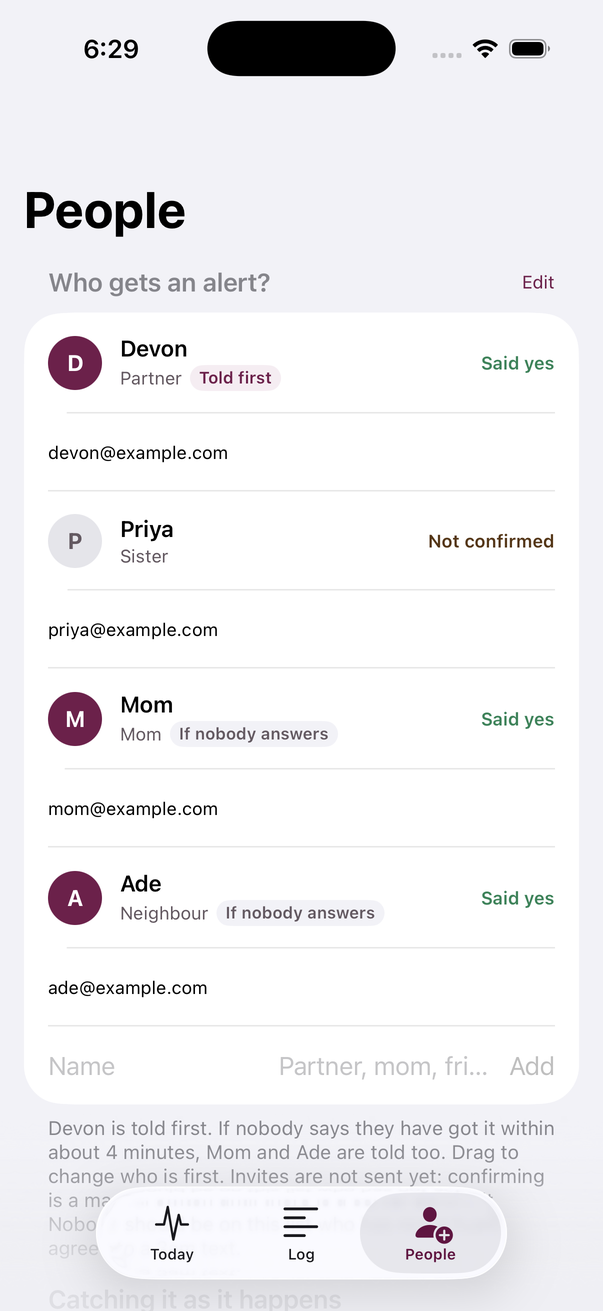
The People screen, showing Devon marked Told first and two other contacts marked If nobody answers

What it watches for, and what it leaves alone.

Most products in this category keep this list in a settings screen. It is on the front page because the scope is the product: a detector that claims everything has to be tuned so loosely that you end up muting it, and a muted app has never helped anybody.

Built for

  • Going down and staying down
  • Slow collapses with no impact, which is the case it exists for
  • Telling you before it tells anyone else
  • Keeping a log worth handing to a cardiologist

Out of scope

  • Going down onto a bed or a sofa, on purpose
  • A stumble you catch yourself out of in a second or two
  • Any moment the phone is not on you
  • Why you went down. It saw a descent, not a diagnosis.

Nothing in this category catches everything. Saying which is which up front is the difference between a miss you forgive and one you don't.

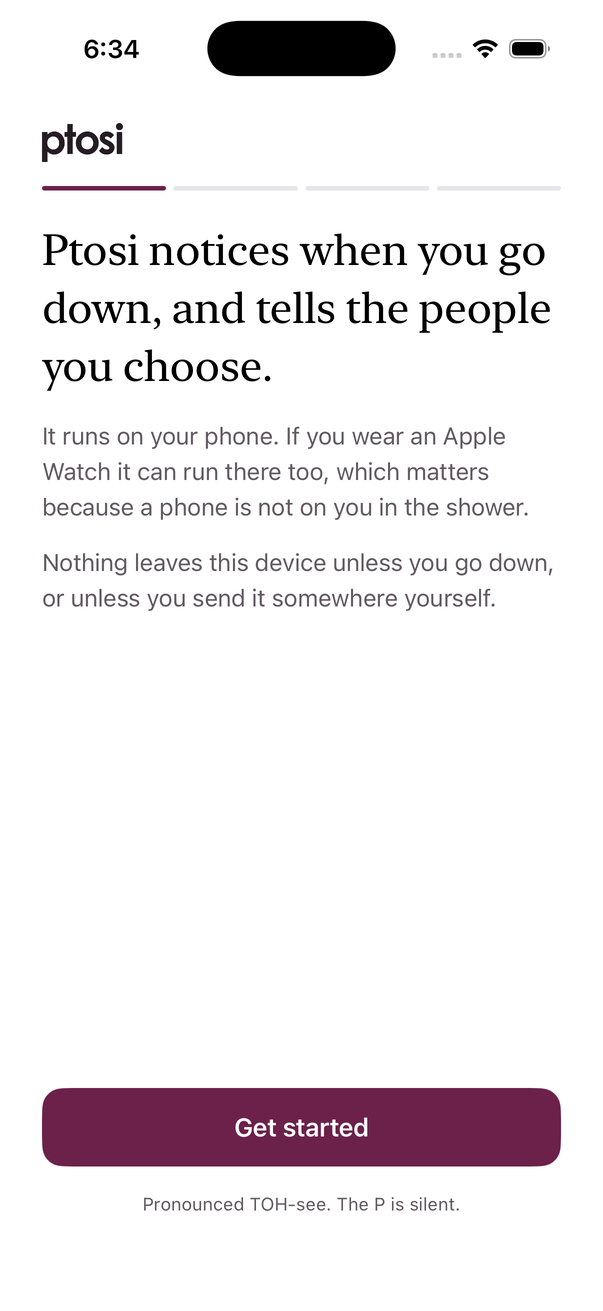
The first onboarding screen, reading Ptosi notices when you go down, and tells the people you choose

Your phone is not on you in the shower.

Which is a problem, because the bathroom at 3am is the exact situation people describe when you ask them what they are afraid of. A watch is on the wrist for both. It has the same barometer, and it runs the same detector, so a wrist reading is not a second guess at the same question.

The watch app is built and in testing. It is not finished: watchOS gives an app about an hour of background time without dressing itself up as a workout, and that trade is not settled yet. It will be said plainly here when it is.

Nothing leaves your phone unless you go down, or unless you send it somewhere yourself. There is no account.

Ptosi's pterodactyl, wings out

For people who fall with finesse.

Not all falls are created equal. Some land hard enough that any phone in the room notices. Others are a slow fold onto the carpet that barely registers as anything, and those are the ones nothing on the market is looking for. If you faint, or you have POTS or dysautonomia, Ptosi was built for the quiet ones.

TestFlight only for now. There is no App Store release and no price yet. Invites go out by hand, so it will be me replying, not a robot. Your email is used to send you the invite and nothing else.